About Kelly
One very particular focus: skin.
I've never really thought of what I do as simply running a cosmetic clinic.
Call Kelly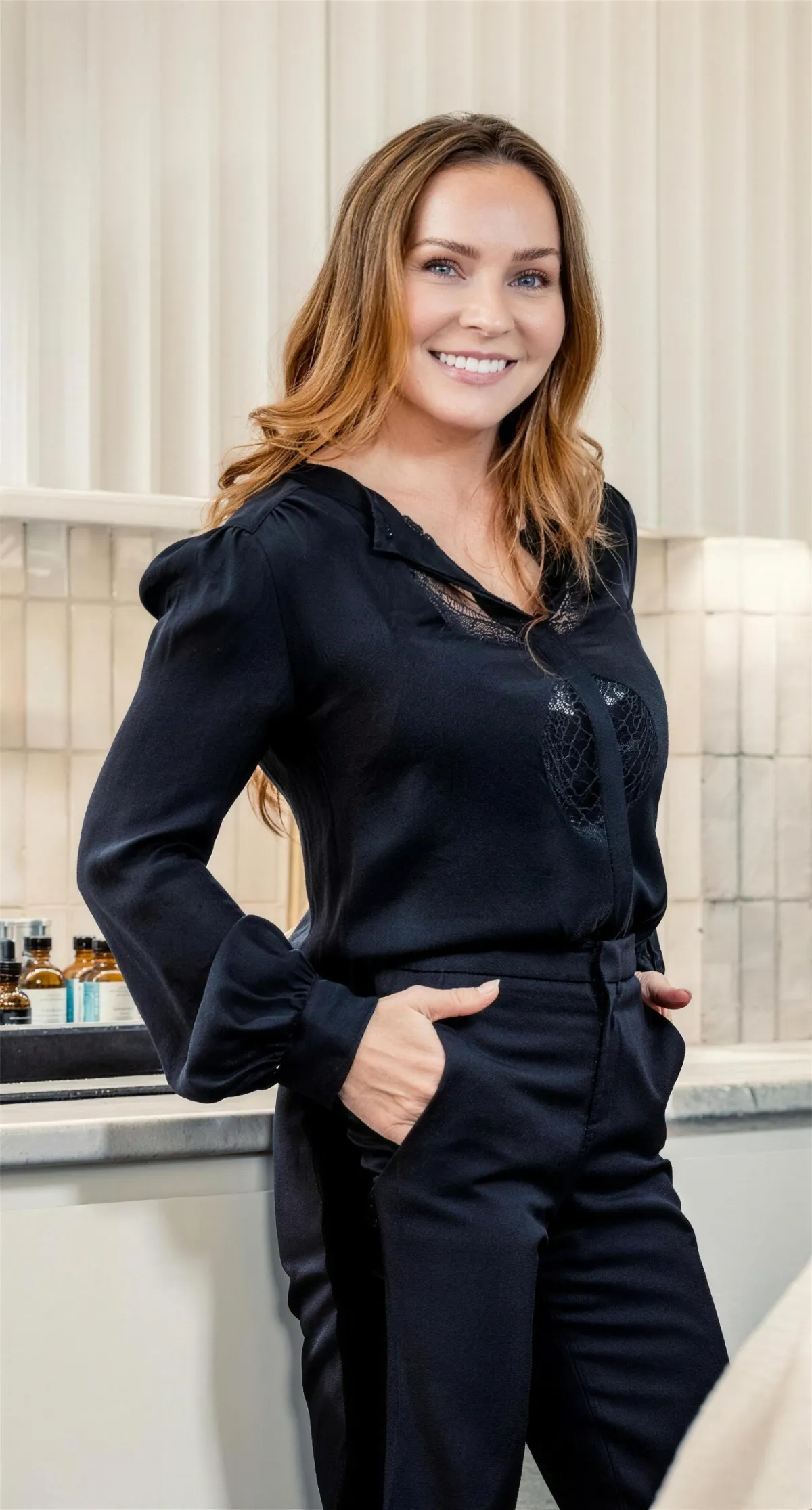
Who is Kelly McNamara?
About Kelly McNamara
My professional life has revolved around skin, technology and understanding what happens when the two meet.
I'm incredibly lucky to have found my niche. Not everyone gets to discover something they're genuinely fascinated by, become very good at it and still love doing it.
I did. And I'm still learning.
How it all started
I began my career in California in 1999, working in Santa Barbara and Beverly Hills before eventually making Sydney home.
Alongside my studies at UCLA, I worked as a private flight attendant on privately owned and chartered aircraft in Los Angeles and Sydney to help fund my education.
It was an unusual combination of careers, but looking back, those years taught me a great deal about the way I wanted to work.
Discretion. Attention to detail. Anticipating what someone needs before they have to ask. Being organised. Being punctual. Looking after people properly.
Those principles have stayed with me throughout my career.
I initially thought nursing would be my path, but I soon realised my fascination was really with skin therapy, photothermology and the emerging world of laser technology.
I didn't just want to know how to operate a machine.
I wanted to understand why it worked, what the energy was doing within the skin, where it was going, and when it absolutely shouldn't be used.
That distinction has shaped everything I've done since.
I am a cosmetic skin practitioner. I am not a doctor or a nurse, and I do not diagnose skin conditions.
Credentials
- Graduate Certificate in Cosmetic Laser & Light Therapies 2015 10038NAT
- Graduate Certificate in Intense Pulsed Light & Laser Hair Reduction 2015 SIB70110
- Cosmetology USA 1999
- Beauty Therapy
- Dermal Therapy 2006
- UCLA Nursing Studies 2004
- New Zealand College of Appearance & Medicine
- Fuss Cosmetic & Laser College NSW
- Laser Safety with Professor Dean Akmead
- ASAPS Aesthetic Course in Cosmetic Medicine
- Cosmetex Lectures 2006-2014
- Certificates in Dermal Resurfacing
- Professor Lee Collins Laser Safety Officer 2012
- Trained in ELOS and Fotona safety operations
- Fotona Laser Certification 2011
- Fotona Laser Training 2012
- Syneron elōs Training
- Syneron Sublative Rejuvenation Training
- Dermaviduals Skin Consultations Module 2015
I studied nursing, but I am not a registered nurse or a doctor, and I am not registered with Ahpra. I am a cosmetic laser and skin practitioner. I do not diagnose or prescribe.
What makes an expert?
You don't get a certificate for experience
I'm quite particular about the word expert.
A certificate tells you that someone has completed training. It doesn't tell you what happens after that.
True expertise comes from thousands upon thousands of hours of actually treating people, seeing different skin types, different concerns, different responses, different complications and different outcomes, and learning how to make decisions when the skin in front of you doesn't behave exactly like the textbook said it would.
That experience changes the way you see skin.
I know when to treat, when to wait, when to change direction, when to increase the intensity, when to back it off and when to simply leave the skin alone.
I don't treat skin according to a script. I treat the skin in front of me.
Over the years, I've worked extensively with lasers, IPL, radio frequency, CO2 and other energy-based technologies, working on pigmentation, vascular concerns, sun damage, texture, collagen, the look of scarring and the visible changes associated with ageing.
I became one of Australia's early Dermapen practitioners.
Surgery can change the architecture of the face. My work is often about the skin that sits over it.
Pigmentation. Vascular irregularities. Sun damage. Texture. Collagen. Scarring. Skin quality.
That is where I come in.
Where do I go against the grain?
I don't believe the person with the most machines, the longest treatment menu or the biggest collection of certificates necessarily has the best understanding of skin.
And I think the word expert has become too easy to use.
For me, expertise is not about how many technologies I can list. It is about understanding what is actually happening in the skin when I use them, and knowing when a treatment should, and should not, be used.
I think about skin in layers.
I'm looking at the surface, but I'm also thinking about the dermis, pigmentation, vascularity, collagen, inflammation, barrier function, tissue quality and the way the skin is likely to respond to thermal energy.
I'm thinking about what I want to change, how deeply I need to work and what the skin can realistically tolerate.
The objective is to create the right response, not simply the biggest response.
How do I choose technology?
Skin first. Technology second.
I have never believed in buying a machine simply because it is new, fashionable or heavily marketed.
I invest in technology because my clients need it.
Many of my clients have been with me for years. Some first came to me in their thirties or forties and are now in their sixties. Their skin has changed over the years, so my technology has had to change with them.
I've deliberately invested in more sophisticated treatments because I didn't want my long-term clients to reach a point where their skin needed something more and they had to go somewhere else to find it.
That is why you'll find different technologies in my clinic.
Not because I want to sell you more treatments.
Because different skin needs different things.
Sometimes the answer is IPL. Sometimes laser. Sometimes radio frequency, resurfacing or CO2. Sometimes it's a carefully sequenced combination.
And sometimes the best treatment is to wait.
My work with Dermaviduals and corneotherapy also reinforced something I feel very strongly about: healthy skin has a barrier for a reason.
I don't want to continually strip, stimulate and overwhelm the skin simply because I can.
Beautifully treated skin should not just look good immediately after a procedure. It should remain healthy enough to respond well over time.
I don't chase the newest thing
The aesthetic industry moves quickly.
New devices arrive. Familiar technologies are given new names. Older ideas are repackaged as breakthroughs.
I'm interested in new technology, but I want to understand it first.
What does it actually do? Where does the energy go? What problem is it solving? How does it compare with what I already have? And does it genuinely give my clients something better?
If the answer is yes, I'm interested.
If it isn't, I'm perfectly happy to leave it alone.
I don't believe in making skin complicated for the sake of selling something complicated.
I believe in understanding the fundamentals extraordinarily well and then using technology intelligently.
Why am I a sole practitioner?
Why I'm still a sole practitioner
I'm a sole practitioner by choice.
Yes, I'm a perfectionist. Yes, I'm probably a little bit of a control freak. And I'm perfectly aware that I could make my life easier by handing clients over to someone else.
But I don't want to.
When you come to Longevity Lounge Esthetics, you get me.
I assess your skin. I choose the technology. I perform your treatment. I see how you respond. I follow your progress. And if you're wondering afterwards whether something is normal, I'm the person you can text.
There's no hand-off.
I deliberately keep my client numbers limited because I want to know the people I treat. I want to remember where we started, what we've done, how your skin responded and where we're going next.
That continuity matters.
I'm not interested in chasing clients
I don't spend my life trying to fill appointment books or build a chain of clinics.
Most of my practice has been built through word of mouth, referrals and people finding me when they're looking for someone with my particular experience.
I've had the privilege of treating generations of clients. Some have stayed with me for many years. Some have become friends. Others have brought their partners, families and closest friends.
I'm incredibly grateful for that.
If you've been coming to me for years, you'll receive the same personal attention you always have.
And if you've just found me today, you'll receive exactly the same care.
This is my work, but it's also my life
I've never been in this for the spreadsheets.
I've never been interested in counting how many people I can fit into a day, chasing trends or treating skin according to whatever happens to be fashionable that year.
I'm here because this is what I know how to do, and this is what I love doing.
I've found something that suits me so completely that it has become an extension of my life.
I've learned that great skin treatment is rarely about doing more.
It's about understanding more.
Understanding the skin. Understanding the technology. Understanding when to intervene and when to wait. Understanding the person sitting in front of you.
That is my difference.
I don't treat trends. I treat skin.
And that is still exactly what I want to do.
Why do I combine treatments?
One treatment rarely does everything
Because skin is not one problem.
Pigmentation is different from laxity. Laxity is different from texture. Texture is different from collagen loss. Sometimes the most beautiful result comes from treating several of those things in the right order, rather than asking one treatment to do everything.
This is something I've been doing for around 20 years.
Interestingly, stacking treatments has recently become a bit of a buzzword in aesthetics. I find that quite amusing, because to me, it has never been a trend.
It was simply the way I learned to get better results.
Over the years, I've watched how skin responds to different wavelengths, different depths of energy and different types of stimulation. I started combining treatments because it made biological sense, not because somebody gave the approach a new name.
What I mean by "stacking"
When I talk about stacking, I don't mean throwing treatments at the skin.
I mean using different modalities for different jobs.
For example, a carefully planned treatment may address pigmentation first, then use radio frequency to work on firmness and collagen, followed by a light fractionated CO2 treatment to refine the surface and encourage further remodelling.
Each treatment has a purpose.
The pigmentation treatment addresses unwanted pigment. The radio frequency delivers controlled thermal energy deeper into the tissue, where we are looking to stimulate collagen remodelling and improve firmness. The fractionated CO2 creates microscopic columns of controlled thermal injury, encouraging the skin's natural repair and resurfacing processes.
Three different jobs. One carefully considered treatment plan.
That is very different from simply doing the strongest possible version of one treatment.
Why don't I just turn the machine up?
Why I don't just turn the machine up
There is a tendency in aesthetics to think that more energy must mean more results.
I've never believed that.
More heat isn't automatically more collagen. More passes aren't automatically a better result. More downtime isn't proof that a treatment has worked harder.
The skin responds according to the wavelength, energy, depth, delivery method, tissue characteristics and, importantly, the person in front of me.
That is why I'm so particular about treatment parameters.
I'm constantly thinking about what I want to achieve at the surface, within the dermis and deeper within the tissue, and how I can stimulate those different targets without simply overwhelming the skin.
That is where experience matters.
I don't see pigment as simply "brown"
This is particularly important with pigmentation.
A brown mark is not automatically the same as another brown mark. Pigment can have different causes, sit at different depths and respond very differently to treatment.
That is why I don't believe in putting every pigmentation concern under the same handpiece.
I want to understand what I'm looking at first.
Sometimes the right answer is laser. Sometimes IPL. Sometimes a different wavelength or approach. Sometimes the skin needs to be prepared before we treat the pigment. And sometimes the smartest decision is to leave it alone.
Treating the right thing is more important than simply treating what you can see.
Can it save you time?
Your time matters.
Your money matters.
And I don't like wasting either.
If I can appropriately combine treatments rather than asking you to come back repeatedly for separate appointments, I want to consider that.
That doesn't mean everything should be done in one visit. Some treatments need to be separated because the skin needs time to respond and recover.
But where treatments can be appropriately sequenced, stacking can allow me to address several concerns within the same overall treatment journey.
That can mean fewer appointments, less disruption to your life and, sometimes, a more complete result.
If pigmentation can be effectively treated in three well-planned sessions, I don't want to stretch it into six simply because I can.
If deeper collagen remodelling genuinely requires a series, I'll explain why.
I'm not interested in selling you a number of treatments.
I'm interested in getting you the result those treatments are supposed to achieve.
Not doing more. Doing more intelligently.
Why do my directions matter?
This is why my directions matter
My treatment doesn't end when you leave the clinic.
The skin continues to respond, repair and remodel.
That is why I can be very particular about aftercare.
What happens between appointments can be just as important as what happens during the appointment.
Sun exposure matters. Skincare matters. Recovery matters. What you put on the skin matters.
And sometimes, what you don't put on the skin matters even more.
I can give you an excellent treatment, but once you leave my clinic, I can't control what happens next.
That part is a partnership.
And then there are the products
On selected laser treatments, I may apply specific topical solutions or products as part of the protocol.
I'm not doing that because every laser treatment needs a serum afterwards.
I'm doing it when I believe there is a reason.
Certain fractional treatments temporarily alter the skin's permeability, and this can be used to help deliver carefully selected topical ingredients when appropriate.
So when I place a carefully selected solution over appropriately treated skin, I'm thinking about delivery, timing and what the skin needs at that particular stage.
And not every product belongs on every treatment.
That distinction is important.
The spray tan rule
There is one instruction I am particularly adamant about after pigmentation treatments:
Please do not spray tan.
I know it can be tempting, especially if you have an event coming up.
But after pigmentation removal, the skin can look completely clear on the surface while small amounts of residual pigment are still sitting underneath or continuing to clear.
A spray tan adds colour to the surface of the skin, and that colour can settle into recently treated areas and make previously subtle pigment look obvious again.
And this is the part people often misunderstand:
Washing the spray tan off does not necessarily mean you've undone the problem.
If the colour has settled into areas of recently treated skin, it can complicate what we are seeing and make it appear that pigment has returned when the original treatment may have been progressing perfectly well.
So when I tell you not to spray tan, it isn't me being difficult.
There is a reason.
And if you choose to ignore that instruction, it may ultimately mean more time, more treatment and more expense to get you back to where we were.
Following my directions is part of protecting the result we are working towards.
I'm particular for a reason
I know I'm particular.
I'm particular about settings. I'm particular about timing. I'm particular about what goes on the skin afterwards. I'm particular about when we repeat something and when we don't.
But there is a reason for all of it.
I'm trying to protect the result.
I don't want to spend your money correcting something that could have been avoided with a little patience or by simply following the instructions.
I would much rather give you fewer, better-planned treatments and have you walk away thinking:
That was absolutely worth it.
I put in the time. I do the work. I respect the skin. And I expect the treatment plan to make sense.
What are you actually investing in?
When you come to me, you are not simply investing in a machine treatment.
You are investing in the decisions behind it.
You are coming for my judgement, my experience and the way I put the pieces together.
Which technology?
Which wavelength?
Which depth?
Which intensity?
Which sequence?
How long between treatments?
What goes on the skin afterwards?
And perhaps most importantly:
When should we stop?
I don't treat the skin according to what the machine can do.
I choose what the machine does according to what the skin needs.
That is where I go against the grain.
Three treatments
The Longevity Method
The Longevity Method is an ultralight cool laser followed by a carefully selected peel, followed by a mask and LED.
This can be done once a month, 3 to 4 times, for a great pick-me-up. It can also be done in between the larger, deeper sessions or just as a one-off for a polish.
MelaJade
MelaJade is one of my favourite treatments when I want the skin to look lighter, tighter, clearer and beautifully polished.
It's a combination treatment using a very light 1064 nm Q switched laser to gently target and break up excess pigmentation, followed by 532 nm KTP to address superficial pigmentation and redness.
The combination gives the skin more than just a pigment treatment. It creates a beautiful tightening and refining effect, helping to diminish redness and soften the appearance of uneven pigmentation, while leaving the skin looking fresh, clear and incredibly polished.
I particularly love it for that light, tight, polished effect. It is not a resurfacing treatment. It is a carefully considered combination of wavelengths designed to clean up the colour of the skin while giving it that fresh, refined glow: clear skin, less redness and a tighter, more polished finish.
Radio frequency offering
Matrix RF uses pins to deliver controlled radio-frequency energy into the skin at a precise depth. This creates controlled bulk heating and fractionated resurfacing, stimulating collagen remodelling and improving the overall quality and firmness of the skin.
The second one is ReFirme. This is radio frequency and infrared light. This is to be done in a sequence of four or five, spaced 3 to 4 weeks apart, and can be stacked with other modalities.
The third one is our photo rejuvenation (IPL, non-laser), once again also from Syneron, among others. This is going to break up pigment and reduce redness.
What machines do I use?
My machines
The skin scanner, known as the satellite skin scanner, is a great start to my consultations, though I don't use it to upsell clients or scare them as they have a deep look into their skin. I simply use it for my own knowledge, and I'm able to choose appropriate modalities and discuss where the client's main concerns are, because what the skin scanner will show us are things that we can't even see half the time. So my favourite part to use it is to show them before and after photos and how their skin is improving, not how scary their skin is and all the things they should be doing. There's a right way and there's a wrong way to use it. There's an ethical way and there is an unethical way, as with everything, I guess.
I've upgraded my CO2 laser. We can do the whole body, and we can do a very light spray for that tissue crepey fine skin over the body and also over the face and neck.
Anything new, changing, crusty or bleeding needs to be checked by your GP or dermatologist first.
I also have a diode laser for hair removal. We can see exactly how much hair you have lost from your last session and guide you with an idea of how many sessions you are in for.
I also have a picosecond laser. It's another option, as some people like to break up the pigment with lesser downtime.
Why these machines
This is interesting because I've not gone outside of what I've been using for years, because in my practice I really do focus on only so many things and not every single thing.
In today's time, we have the opportunity to buy several machines at one time, because with the skin we treat, there's just not one condition.
Other machines
Over the years, I've built my clinic around having more than one way to treat the skin. My technology includes Fotona, Pico, Stella RF, Centaur, a skin needling pen, ReFirme, Matrix RF, Sublative Rejuvenation RF, Syneron IPL, Syneron ST ReFirme and Sublime ST skin tightening.
Each machine has its own strengths, and each plays an important part in what I can achieve for you.
Some of these technologies can treat similar concerns, but not every skin can have the same treatment. If you can't have laser but need resurfacing, I have another modality. If radio frequency isn't suitable but you need scar treatment, I have another option.
That means I'm not limited to one treatment for one condition. I have different technologies, different approaches and different price points to suit different skin and different people.
And this is where my years of experience really come into play.
I can also stack and combine these technologies to create treatments that aren't necessarily on my treatment menu. I call these my OFF-SCRIPT treatments, combinations developed through years of treating skin, learning what works together and, most importantly, seeing the results.
That's what brings my clinic to life: I'm not just choosing a machine. I'm choosing the right technology, or combination of technologies, for your skin.